
Commercial Solar for Ventura County Wineries: A Practical Guide
A 50 kW commercial solar array on a typical Ventura County winery pays back in 4 to 6 years and slashes summer demand charges by 60–80%. Here's how the economics work.
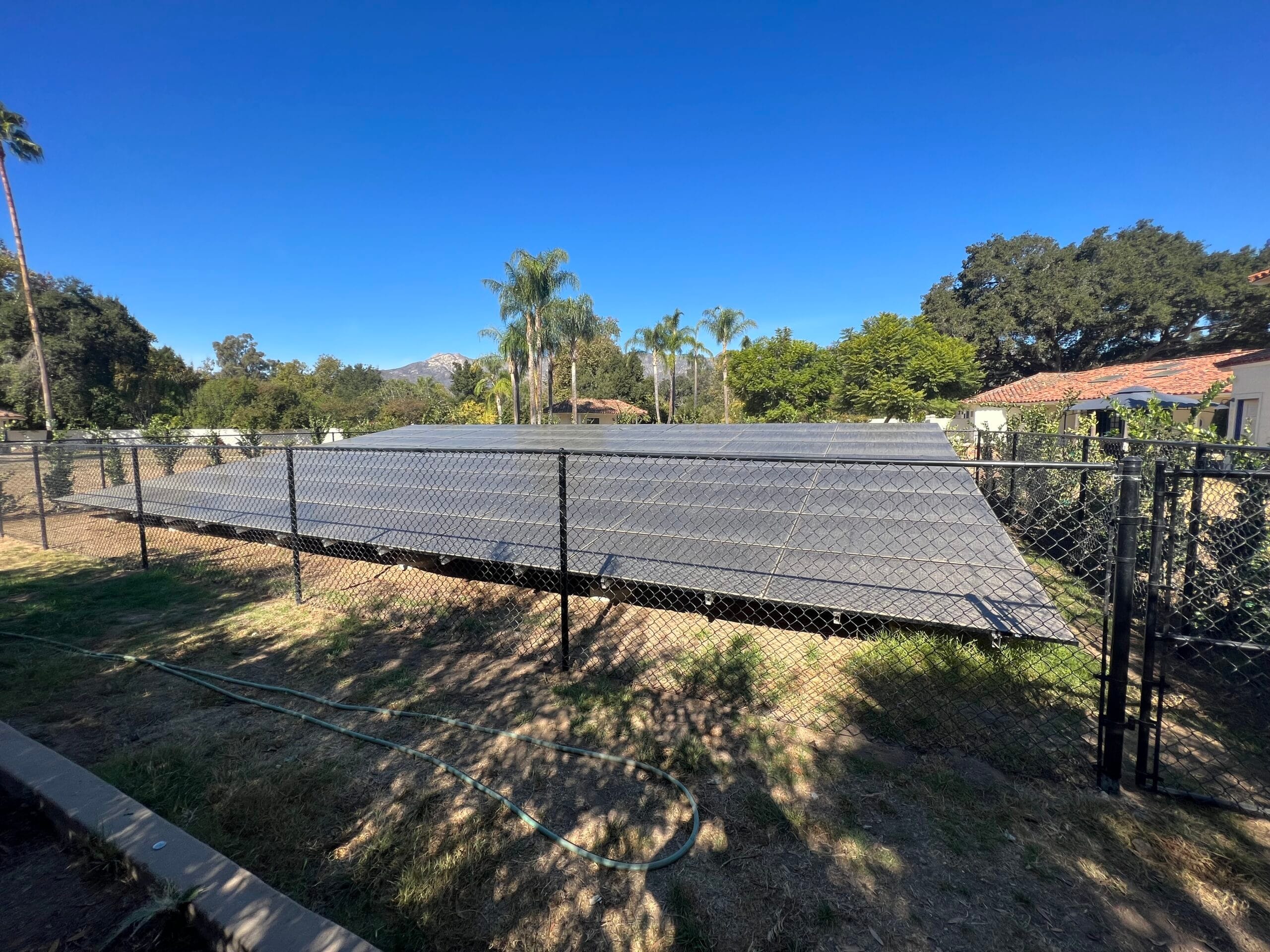
We've installed commercial solar systems on more than a dozen wineries and vineyards across Ventura County and the Santa Clara Valley — from boutique operations in Ojai to larger crush facilities in Santa Paula. Wineries are one of the highest-ROI applications of commercial solar we see, and here's why.
Why wineries are an ideal solar candidate
- Large, unshaded south-facing roofs (production buildings, barrel rooms, equipment sheds)
- Heavy daytime electrical loads — refrigeration, glycol chillers, crush equipment, lighting, HVAC
- Demand charges from SCE that often exceed 40% of the total electric bill
- Significant ground space for ground-mount or carport-mount solar where roof space is limited
- A long-term ownership horizon — wineries don't move
The two costs you're attacking
A typical Ventura County winery on SCE's TOU-GS-3 or TOU-8 commercial rate has two cost components: energy charges (per kWh) and demand charges (per kW of peak instantaneous load). Solar alone reduces energy charges. Solar + battery reduces both.
Demand charges are often the killer. A single 30-second spike from a glycol chiller starting up during peak hours can set your demand charge for the entire month. Battery storage smooths these peaks invisibly.
Realistic system sizing for a Ventura County winery
- Boutique winery (5,000 cases/year): 30–50 kW solar, 60–120 kWh battery
- Mid-sized winery (10,000–25,000 cases): 75–150 kW solar, 200–400 kWh battery
- Production facility (50,000+ cases): 200–500+ kW solar, 500 kWh+ battery
Incentives stack favorably for wineries
Federal Investment Tax Credit (ITC)
30% of the total installed system cost, claimable in year one. This applies to both the solar array and the battery storage. Bonus credits of an additional 10% are available for systems built with domestic-manufactured equipment, and another 10% for systems located in 'energy communities.' Many parts of Ventura County qualify for at least one bonus.
Modified Accelerated Cost Recovery (MACRS)
Commercial solar can be depreciated on a 5-year MACRS schedule, with 60% bonus depreciation in year one (2026 schedule). For a winery in the 35% effective tax bracket, this typically reduces effective system cost by another 22–25%.
California SGIP
Self-Generation Incentive Program rebates of $200–$1,000 per kWh of installed battery storage. Wineries in High Fire Threat Districts (much of the Santa Clara Valley and Ojai watershed) qualify for the higher 'Equity Resiliency' tier.
What payback actually looks like
After the federal ITC, MACRS depreciation, and SGIP, a typical Ventura County winery sees an effective net cost of roughly 35–45% of the gross system price. Combined with $20,000–$60,000+ per year in avoided utility costs, the typical payback period is 4 to 6 years for solar + battery systems on wineries we've installed.
Operational benefits beyond the bill
- Resilient crush season — battery backup keeps fermentation control, glycol, and refrigeration running through PSPS events
- Marketable sustainability story for direct-to-consumer and trade audiences
- Carbon-free production credentials for export and on-premise sales
- Predictable energy costs over a 25-year horizon
Frequently asked questions
Can solar power a glycol chiller?+
Yes. Glycol chillers are well-suited to solar+battery systems because their loads are predictable and largely daytime-aligned. Battery storage handles startup surges and overnight refrigeration.
Do I need to take my winery offline for the install?+
No. We schedule installs around your operations, including crush. The grid-tie cutover itself takes 2–4 hours and is typically scheduled at dawn.
What about ground-mount vs. rooftop for vineyards?+
Both work. Rooftop is cheaper per watt and uses no land. Ground-mount allows larger systems and is often paired with sheep grazing or pollinator habitat. Many of our larger winery systems are hybrid — rooftop on the production building and ground-mount in a back lot.
How long does a commercial winery solar project take?+
From contract to commissioning, expect 4–7 months. Permits and SCE interconnection are the longest steps. Active install is typically 3–6 weeks.