
Tesla Powerwall vs. Enphase IQ Battery: Which Is Right for Your California Home?
Both Powerwall and Enphase are excellent. The right choice depends on your existing solar inverter, how much backup you need, and whether you want one big battery or several smaller ones.
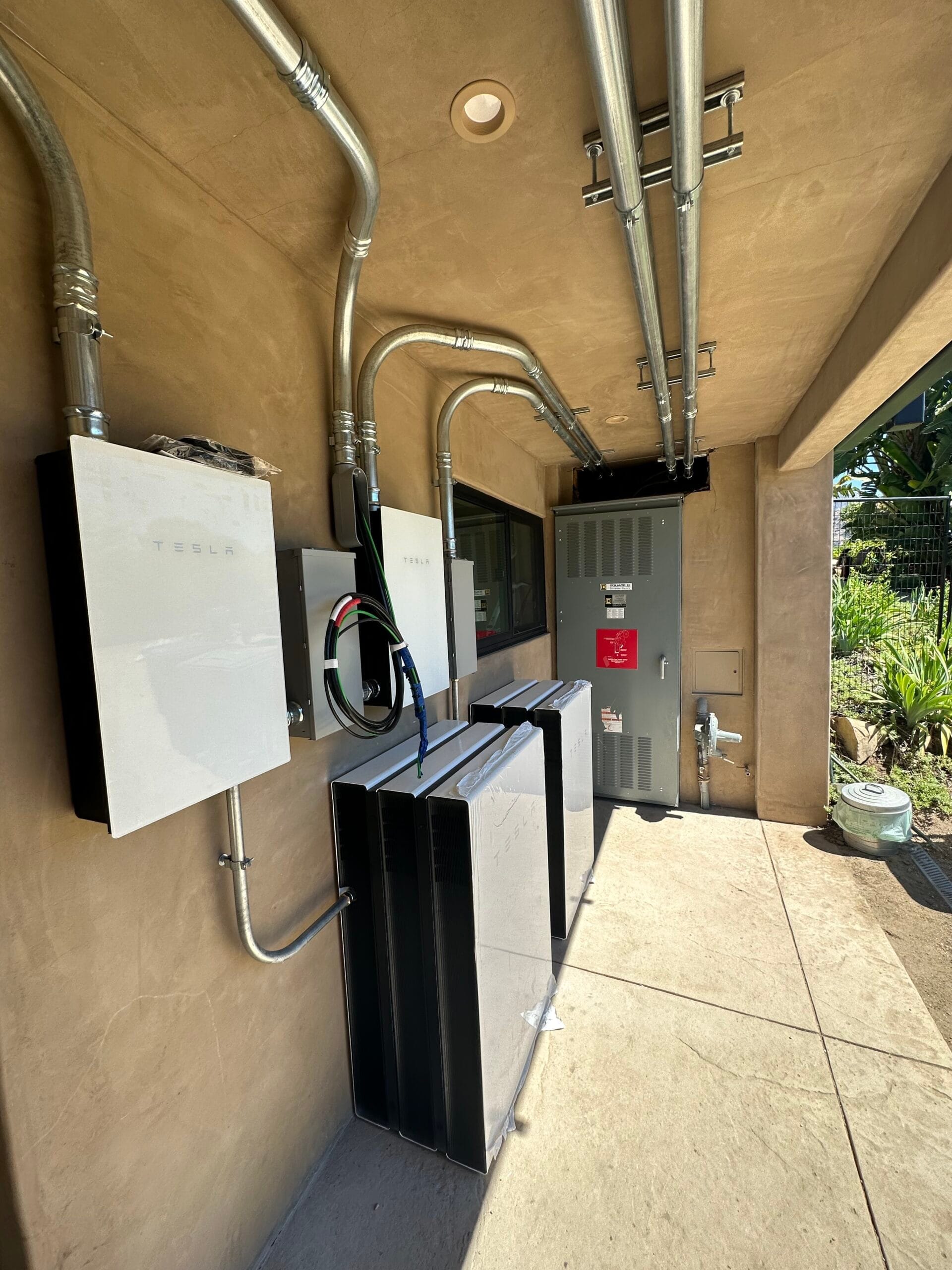
We install both Tesla Powerwall and Enphase IQ Battery systems every week across Ventura County, and the question we get more than any other is: which one should I buy? The honest answer is that both are excellent, but they're optimized for different homes. Here's how we actually decide between them when we walk a customer's site.
The 30-second summary
- Tesla Powerwall 3 — best for newer homes, larger loads, and customers who want one big battery with built-in solar inverter capability.
- Enphase IQ Battery 5P — best for homes that already have Enphase microinverters, complex roofs, or want a modular system you can grow over time.
Capacity and power
A single Powerwall 3 stores 13.5 kWh of usable energy and delivers 11.5 kW continuous power — enough to run a typical Ventura County home (including the AC) without load-shedding. The Enphase IQ Battery 5P stores 5 kWh and delivers 3.84 kW continuous, but you stack them in groups of 2–4 to match a Powerwall's capacity.
For a 2,500 sq ft home with central AC and an EV, you typically need either one Powerwall 3 or three IQ Battery 5P units to get equivalent whole-home backup capability.
Price comparison (2026, installed in Ventura County)
- Tesla Powerwall 3: $13,500–$16,500 installed, single unit with built-in solar inverter
- Enphase IQ Battery 5P (3-pack ≈ 15 kWh): $18,000–$22,000 installed
- Both qualify for the 30% federal ITC when paired with new solar
- Both are eligible for SGIP rebates in California (especially in High Fire Threat Districts)
Backup experience: what's it actually like in an outage?
When SCE has a Public Safety Power Shutoff (PSPS) or storm outage in the Ojai or Santa Paula area — which has happened to several of our customers more than once — both batteries kick over in under 100 milliseconds. You won't notice a flicker.
Powerwall's whole-home backup is more graceful with large surge loads (think well pumps, central AC compressors, or an EV charging at 11.5 kW). Enphase handles these too but typically requires careful load management, which we configure during install.
Warranty and longevity
- Tesla Powerwall 3: 10-year warranty, unlimited cycles, 70% capacity retention guaranteed at year 10
- Enphase IQ Battery 5P: 15-year warranty (industry-leading), 60% capacity retention guaranteed at year 15
On paper Enphase wins on warranty length. In practice we've seen both systems perform well past their warranty in the field.
App experience
Tesla's app is the cleanest, most polished home-energy app on the market. Period. You can see real-time solar production, battery charge, home consumption, and grid import/export on one beautiful screen. You can also set storm watch, time-based control, and self-powered modes with one tap.
Enphase's app is more data-rich and gives panel-level production data (Enphase microinverters track each panel individually), but it's less elegant. Power users tend to prefer Enphase's depth; everyone else tends to prefer Tesla's polish.
Which one we recommend, by home type
Choose Tesla Powerwall 3 if…
- You're starting fresh — new solar + battery install
- You have a single, simple roof plane
- You want one big battery and a clean wall installation
- You drive a Tesla EV (the integration is excellent)
- You want the best app experience
Choose Enphase IQ Battery 5P if…
- You already have Enphase microinverters on your roof
- Your roof is complex (multiple planes, heavy shading, dormers)
- You want to start small and add storage capacity over time
- You value the longest-in-class warranty
- You're a data nerd who wants per-panel production data
Frequently asked questions
Can I mix Tesla Powerwall with non-Tesla solar panels?+
Yes. Powerwall 3 includes a built-in solar inverter that works with any compatible third-party panels. Powerwall 2 also works with virtually any existing solar system through AC coupling.
How many Powerwalls do I need for whole-home backup?+
Most Ventura County homes (1,800–3,000 sq ft, central AC, no EV charging during outage) are well served by a single Powerwall 3. Larger homes or homes with two EVs typically need two.
Is Powerwall 3 better than Powerwall 2?+
Yes. Powerwall 3 has higher continuous power output (11.5 kW vs 5 kW), built-in solar inverter, and better surge handling. We only install Powerwall 3 on new projects in 2026.
Do batteries require maintenance?+
No. Both Powerwall and Enphase batteries are fully sealed lithium iron phosphate (LFP) units with no user-serviceable parts. Both update automatically over the air.